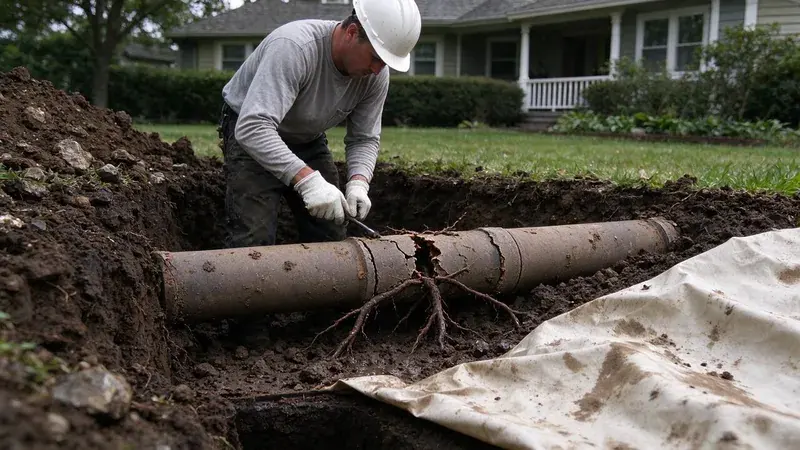
The pipes you never see do some of the most important work in your home. A water service line brings fresh water from the meter, and a sewer lateral carries everything from your drains out to the city main or septic tank. Both are buried, frequently several feet deep, and both can fail without obvious warning. Soil conditions, thirsty trees and aging pipe materials all create specific risks for buried lines in Kansas. The good news is that repairing a buried pipe no longer has to mean tearing up the entire yard.
What Damages Buried Pipes in Kansas
Tree roots are a leading cause of sewer line problems. Fast-growing shade trees such as willows, poplars and silver maples, along with many ornamental species, send roots long distances in search of moisture. A sewer line with a tiny crack or loose joint gives off water vapor and nutrients, and roots find their way in. Once inside, they grow into a dense mass that catches waste and can ultimately split the pipe.
Much of Kansas has expansive clay soil that swells when wet and shrinks in drought, which can shift foundations and stress buried pipes.
Soil movement is another factor. Expansive clay swells during heavy rain and shrinks in dry seasons, while dense soil layers and buried rock resist movement and create pressure points. Over years, that cycle can shift pipe joints, crack rigid materials and create low spots called bellies where waste collects. Heavy vehicles parked over shallow lines and poor bedding during original construction make it worse.
Pipe material matters as well. Older neighborhoods may still have clay tile or cast iron sewer lines, and some homes have galvanized steel water service lines that corrode from the inside out. Homes built from the 1970s onward often have ABS or PVC sewer pipe, which resists corrosion but can still crack, separate at joints or warp under load.
A lot of Kansas housing dates from the mid-century building boom, with galvanized supply lines and cast iron drains.
Warning Signs of Underground Pipe Damage
Buried pipe problems tend to show up indirectly. Watch for these signs:
- Repeated drain backups in multiple fixtures, especially the lowest toilet or shower in the house.
- Gurgling toilets when the washing machine drains.
- Sewer odors in the yard or near a cleanout.
- An unusually green or soggy patch of lawn or landscaping, which stands out during a dry spell.
- Sinkholes or depressions along the path of the line.
- A water meter that keeps moving with every fixture off, pointing to a service line leak.
- Low water pressure throughout the house.
Modern Repair Solutions
Diagnosis comes first. For sewer lines, a plumber feeds a waterproof camera through a cleanout and records the full length of the pipe, noting roots, cracks, offsets and bellies along with their depth and location. For water service lines, pressure testing and acoustic leak detection narrow down where water is escaping. With that information in hand, there are several ways to repair the line.
Cured-in-place pipe lining inserts a flexible resin-saturated liner into the existing sewer pipe, inflates it, and lets it harden into a new seamless pipe inside the old one. It seals cracks and root entry points and typically needs only access at the cleanout. Pipe bursting pulls a new HDPE pipe through the old line while a bursting head fractures the original pipe outward, which works well when the existing pipe is too damaged to line. Spot repair involves excavating one section to replace a single broken joint or belly. For water service lines, directional boring can run a new line from the meter to the house with only small pits at each end.
Costs depend on length, depth and access. A camera inspection usually runs $150 to $400. Spot sewer repairs frequently land between $1,500 and $4,500. Trenchless lining or bursting of a full residential lateral commonly ranges from about $4,000 to $12,000, and a new water service line runs roughly $1,500 to $5,000. Trenchless methods can cost similar to or more than digging per foot, but they save landscaping, hardscape, driveways and pavers from being torn out and restoration.
When to Call a Professional
If drains keep backing up or your water meter shows a leak you cannot find, the next step is a professional inspection. Underground repairs often require permits, utility locates and careful work around gas and irrigation lines. KRV Plumbing uses sewer cameras, leak detection equipment and trenchless repair methods to fix buried pipes with as little digging as possible. Call (316) 229-8459 to schedule an inspection and get a clear explanation of your repair options.
Need a licensed plumber in Kansas?
KRV Plumbing answers 24/7 and offers same-day service across Kansas.